We built Rubicon Probity because we wished it existed. So every important decision gets the thinking it deserves.

Three things, done properly: cut through the noise, make better decisions, and actually follow through.

The problem

AI tools make organisations faster. But faster isn't the same as wiser.

Important decisions vanish

Think about the last big call your team made. Who made it? What alternatives were considered? Most organisations can't answer that three weeks later, let alone three months. The decision is gone — but the consequences aren't.

Nothing connects the decision to what actually happened

Someone said yes. Things started moving. But ask who authorised it, or whether what was delivered matches what was agreed — and you get silence. That gap between “we decided” and “we did” is where organisations quietly lose control.

AI is already making decisions for you — you just don't know which ones

Your teams are using AI tools right now, in every department. Some of those tools are shaping real decisions — and nobody is tracking which ones. No audit trail, no oversight, no way to tell what was a human call and what wasn't.

What most vendors won't tell you

The technical reality of AI-assisted decisions

Your AI gets worse the more you tell it

Every AI has a context window — working memory where it holds your conversation and documents. Chroma's 2025 research tested 18 frontier models and found every one degrades as input grows. Not at the limit — at 25–50% capacity. Stanford's research shows a 30%+ accuracy drop when critical information sits in the middle of the context. The model sounds just as confident when it's lost the plot. There's no built-in warning.

18/18 frontier models degrade with context length

AI is confidently wrong more often than you think

When a model lacks information, it doesn't say “I'm unsure” — it generates something that sounds right. Over 120 cases of AI-driven legal hallucinations have been documented since 2023, with 58 in 2025 alone. No model achieves zero. The danger isn't that people trust AI blindly — it's that AI outputs are hard to verify at scale. When the model generates a 10-page analysis, which facts are real and which are fabricated?

120+ documented AI legal hallucination cases

Every session, your AI starts from zero

LLMs are stateless by design. The moment a session ends, everything is gone — the context, the reasoning, the decisions. For one-off questions, this doesn't matter. For enterprise decision-making — where decisions build on prior decisions, where institutional knowledge matters — it's catastrophic. The same question on Monday and Thursday gets different answers because the context is different each time.

Zero persistent memory between sessions

The cost nobody's tracking

Every word an AI reads and writes costs money. Inference now represents 85% of enterprise AI budgets. Output tokens cost 4–8x more than input tokens. The difference between cached and uncached context is 10x in price. Yet almost no organisation tracks cost per decision. When a £50,000 strategic decision was supported by AI analysis, what did that analysis actually cost? Nobody knows.

85% of AI budgets are inference, not training

These aren't edge cases. They're the baseline reality of every AI deployment. The question isn't whether your AI tools have these problems — they do. The question is whether your decision-making process accounts for them. That's what we built Rubicon Probity to solve.

See how Probity solves this →

Rubicon Probity

Three phases. One joined-up system.

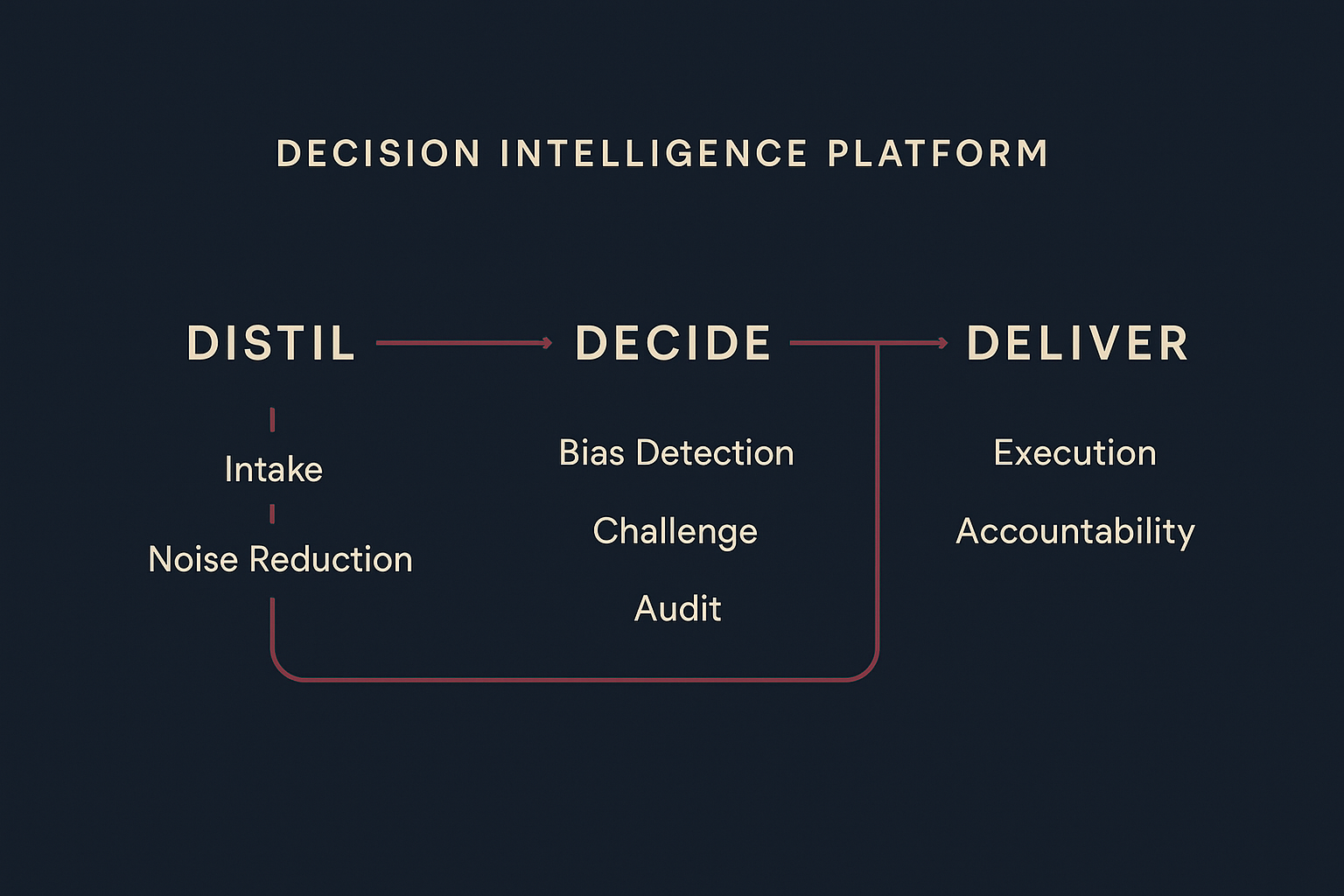
Information comes in messy. Decisions need to be sound. And something actually needs to happen afterwards. Probity handles all three — in one platform, with a single audit trail.

Phase 1

Distil

You're drowning in information. Most of it doesn't matter.

Recordings, documents, emails, voice notes, conversations — everything comes in. Probity extracts what actually matters: decisions, actions, risks, commitments. The rest is discarded explicitly. Because better thinking doesn't come from seeing more. It comes from seeing less, but seeing it clearly.

  • Multi-channel intake — email, voice, chat, web, mobile
  • AI distillation with mandatory tracked outputs
  • Zero-friction capture — no forms, no structure imposed
  • Follow-up tracking with automatic deadline extraction

Phase 2

Decide

AI agrees with everyone. That's comfortable, but it's not helpful.

Probity's two-stage bias detection engine does the opposite: it challenges every consequential decision in real time. Confirmation bias, anchoring, sunk cost fallacy — 153 documented patterns detected and surfaced before you commit. Three verdicts: CLEAR, CAUTION, or STOP. Every decision captured with a full audit trail.

  • 153-bias cognitive detection library
  • Designed to challenge, not to agree — the opposite of sycophantic AI
  • Cognitive Profile that learns your team's decision patterns
  • Immutable decision audit trail with override tracking

Phase 3

Deliver

The gap between a decision and something actually happening is where most organisations lose.

Decisions flow into structured execution. Tasks are tracked, outcomes are recorded, and the loop closes: what was decided, what was done, and what happened. No decision without follow-through. No action without the decision that authorised it. That's how accountability actually works.

  • GTD-based task orchestration with AI prioritisation
  • Focused daily view — three to five things that matter
  • AI execution agents for delegatable work
  • Outcome recording against original decisions
Rubicon Probity architecture: Distil, Decide, Deliver pipeline

What we've built

Our own technology, not a reskin of someone else's

We don't resell other people's AI. Probity is our own technology — built because we needed it, and refined by using it every day. It has its own analysis pipeline, cognitive profiling, and integration layer.

Think Pipeline

Two-stage analysis: fast classification identifies the decision type and stakes, then deep bias detection with reframing and challenging questions. Returns a clear verdict — CLEAR, CAUTION, or STOP — before you commit. Not advice. A structured challenge.

153-Bias Cognitive Library

A comprehensive library of documented cognitive biases, organised by decision stage — from how you perceive information through to how you learn from outcomes. Integrated directly into every analysis, not bolted on as a checklist.

Decision Audit Trail

Every decision recorded as a first-class entity: what was decided, what alternatives existed, what biases were flagged, who made the call, and what happened afterwards. Immutable. Searchable. Built for the moment an auditor asks.

Cognitive Profile

Probity learns how you and your team decide over time. Which biases appear most frequently, how quickly you commit, where your outcomes track well — and where they consistently don't. The feedback loop that makes judgment improve.

Persistent Memory

Our own memory architecture that solves the stateless problem at the heart of every AI deployment. Project context, decision history, and institutional knowledge — persisted across sessions and searchable. The AI remembers what matters because we engineered it to, not because the model does it natively.

Guardrail Engine

Configurable rules that define when a human must review, when the AI can proceed, and what happens when a decision conflicts with your stated principles. Override tracking with rationale capture — every exception is recorded, never silent.

Distillation Engine

Voice notes, transcripts, documents, emails — all processed and classified automatically. Decisions, actions, risks, and commitments surfaced. Noise discarded explicitly. The signal is preserved. Everything else is gone.

Judgment Dashboard

An operational view of every decision in your pipeline — what needs judgment, what's stale, what's blocked, and what's been completed. A decision health monitor that surfaces what you're avoiding and what's drifting without a decision behind it.

Integration Layer

MCP server for AI development environments. REST API for any application. Probity works where your people already work — inside your existing AI tools, not as a separate app you have to remember to open.

AI Clarity Score

Eight honest questions that map where your organisation actually stands with AI — across four dimensions. Takes two minutes. No email required. A good place to start before committing to anything.

For regulated and high-stakes environments

Built for the decisions where getting it wrong really matters

Financial services

Credit decisions, investment approvals, regulatory submissions. When AI assists the analysis, Probity ensures the human judgment layer is documented, challenged, and auditable.

Legal

Case strategy, settlement decisions, risk assessments. Probity captures the reasoning, flags confirmation bias, and ensures alternative positions were genuinely considered — not dismissed.

Healthcare

Treatment protocols, resource allocation, clinical governance. Decisions with direct impact on patient outcomes need traceable reasoning and bias awareness, not just AI-assisted speed.

Technology leadership

Architecture choices, vendor selection, AI adoption strategy. Irreversible technical decisions made under time pressure are exactly where cognitive bias does the most damage.

EU AI Act — August 2026

Governance obligations are four months away

If this feels abstract, it won't for long. The EU AI Act's high-risk obligations take effect on 2 August 2026. If your organisation sells products or services into Europe, you are in scope. Most UK firms haven't started assessing which of their AI uses qualify as high-risk.

Probity gives you what compliance frameworks will ask for: traceable reasoning, documented alternatives, bias detection, human-in-the-loop controls, and proper records. Not bolted on after the fact — built into the way decisions are made from day one.

What auditors will ask

  • How are AI-informed decisions documented? Every decision captured with context, options, and reasoning.
  • What bias controls are in place? Two-stage cognitive bias detection with CLEAR / CAUTION / STOP verdicts.
  • Can decisions be traced after the fact? Immutable decision records with full audit trail.
  • Is there human oversight? Configurable challenge protocols with explicit override and rationale capture.

Ready to see where you stand?

Two minutes. No email required. Find out where AI fits your business — and where the gaps are.

Or skip ahead and start a conversation