The technology has changed many times. What we care about hasn't changed once.

Founded by Alistair Hancock in Cambridge in 1989, we've moved from early membership systems to enterprise web platforms, rules engines, AIM public-company life, long embedded partnerships, and now AI adoption and decision intelligence. Every era, the same question: what does this business actually need?

Origin

Start with the business problem. Build the technology to solve it.

Rubicon began with RSAMS — a fundraising and membership system built while Alistair Hancock was studying Computer Science at St John's College, Cambridge. At a time when most small fundraising operations were still managed on card indexes and paper filing systems, RSAMS was genuinely innovative — and it set the pattern: understand the problem, build something that works, stay around to make sure it keeps working.

What computers are capable of has changed dramatically since 1989. The mission has not: getting computers to do what they are best at so people have more time for what they are best at.

Leadership

Founder-led since 1989.

Alistair founded Rubicon while reading Computer Science at Cambridge and has led the company through every pivot since — enterprise web infrastructure, financial services platforms, public-company governance, embedded renewable energy partnerships, and now AI adoption and decision intelligence.

That continuity matters more than most people realise. When we give advice, it comes from thirty-five years of building and running the systems ourselves — not from a recently assembled advisory practice.

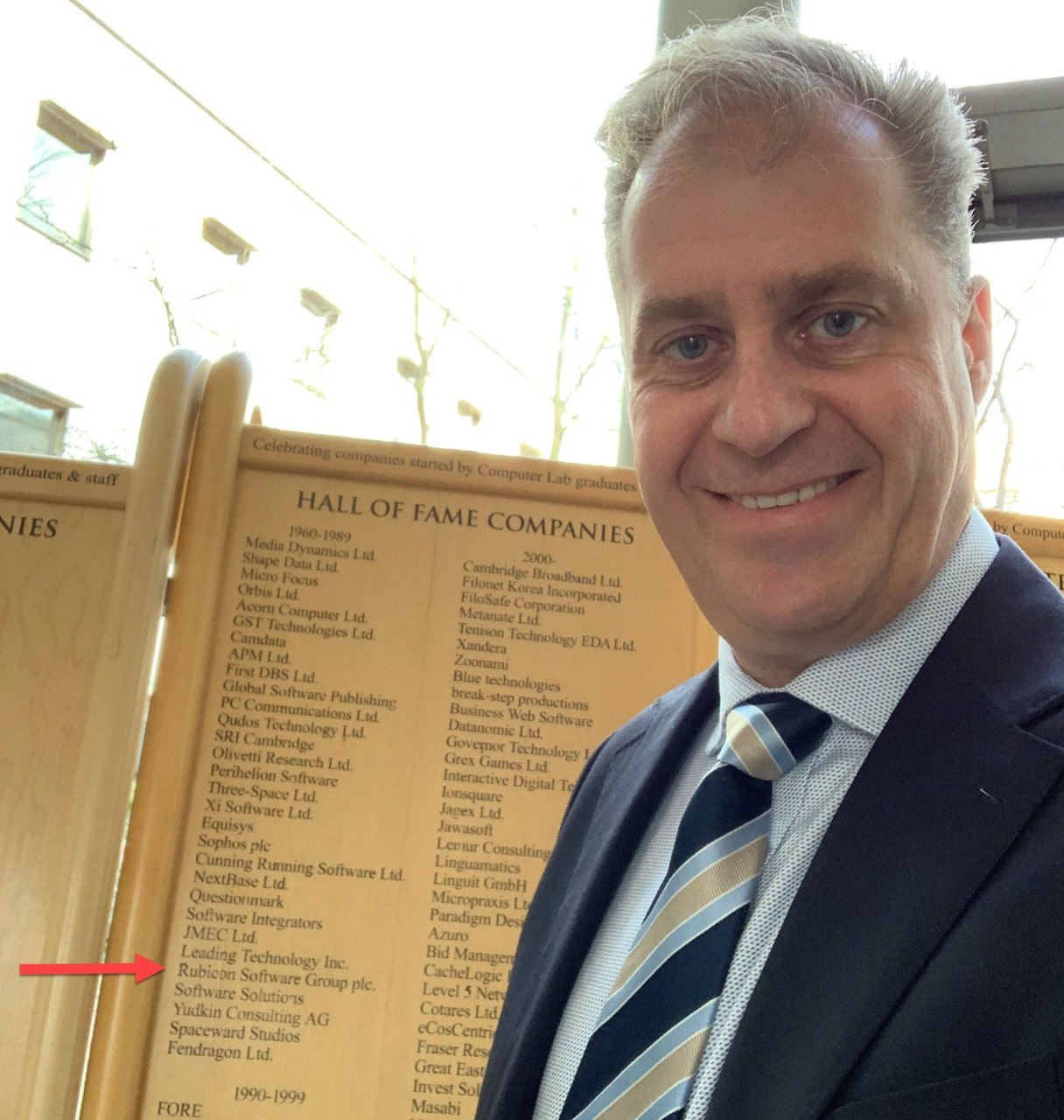
Cambridge Computer Laboratory recognises Rubicon on its Hall of Fame in the William Gates Building - alongside ARM, Sophos, Micro Focus, and Acorn Computer.

Heritage

The company you keep says more than the company you are.

Rubicon is recognised on the Hall of Fame board at Cambridge University's Computer Laboratory - the William Gates Building - alongside ARM, Sophos, Micro Focus, Acorn Computer, RealVNC, and Jagex.

It is a reminder that Rubicon's roots are in one of the most productive computer science departments in the world, and that the discipline of building lasting systems started there. From Cambridge in 1989 to AI in 2026, the thread is the same: start with the problem, build what matters, and make it work under real-world pressure.

Cambridge Computer Laboratory Hall of Fame board - Rubicon Software listed alongside ARM, Sophos, Micro Focus, and Acorn Computer

Hall of Fame board, William Gates Building, Cambridge.

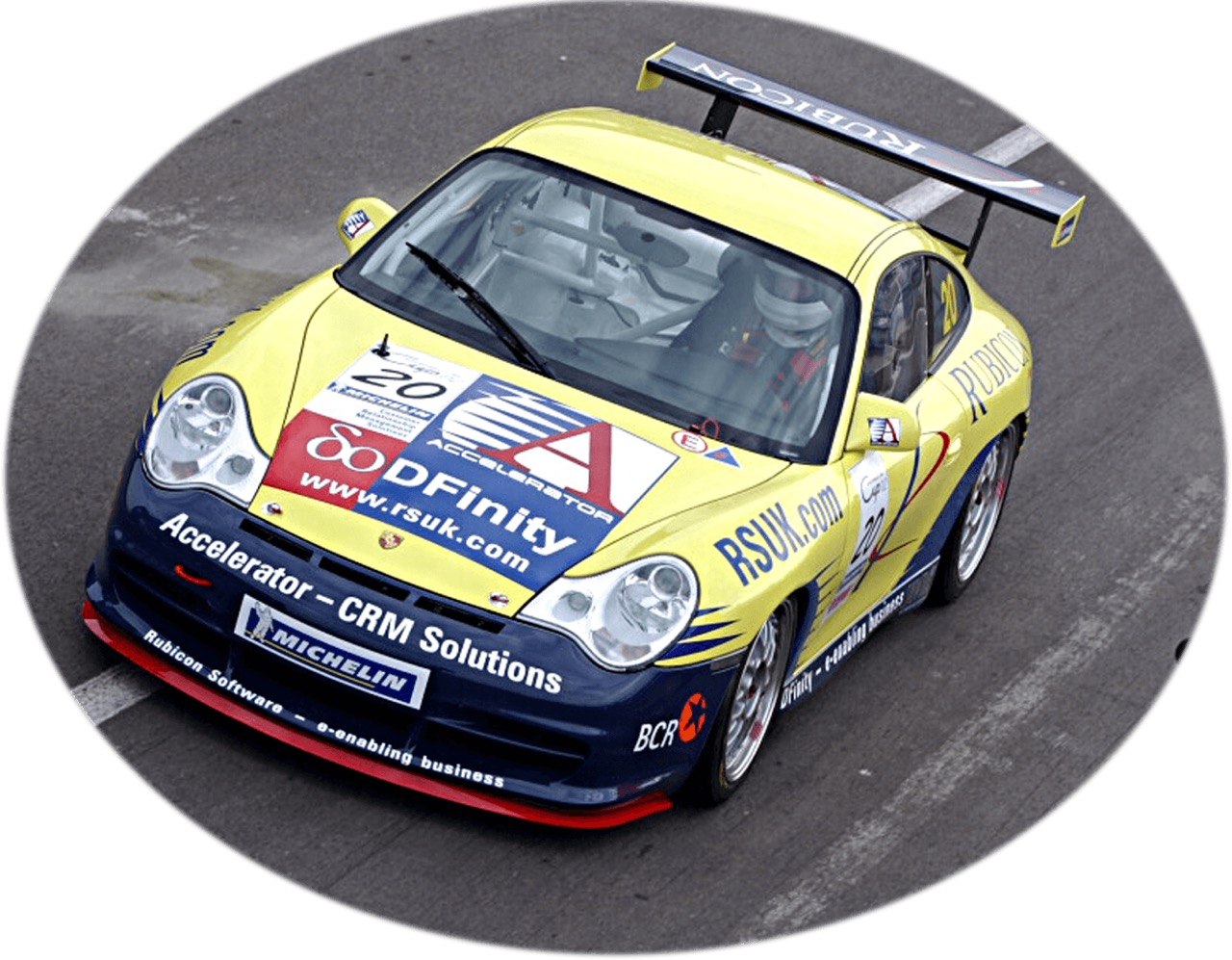
Along the way, we sponsored Team BCR in the inaugural Porsche Carrera Cup GB - car #20 in full Rubicon livery, racing as BTCC support. In 2003 the company still traded as rsuk.com, before the AIM flotation prompted the rebrand to rubiconsoftware.com. Team BCR won the Teams' Championship that year. Not many software companies can say they helped put a champion on the grid.

Porsche 911 GT3 Cup car number 20 in Rubicon Software livery - Team BCR, Porsche Carrera Cup GB 2003

Team BCR, Porsche Carrera Cup GB 2003.

Sharp-eyed readers may notice the DFinity logo on the car, alongside Accelerator and the Rubicon brand. DFinity was our database-driven dynamic web platform - a true CMS before the term existed - built for ICI Paints to power the Dulux UK and Dulux Ireland websites. Every page, every image, every line of content was stored in and served from a database, with multi-site staging environments for live, development and test. It was written in Delphi 5 with an Enterprise Java Beans alternative, and won Borland Application of the Year 2000. In 2016, the DFINITY Foundation in Zürich chose the same name for their Internet Computer blockchain project - but that is another long and fascinating story…

Brand evolution

Rubicon Software logo c.2000

Rubicon 1996

DFinity product logo 2000

DFinity 2000

Accelerator CRM product logo 2004

Accelerator 2004

Rubicon Software Group plc logo 2006

Rubicon 2006

Rubicon Software 2026 logo

Rubicon 2026

History

Shaped by repeated pivots — and a long memory.

Our history matters because what we're doing with AI isn't a clean-sheet reinvention. It's the latest expression of capabilities we've been building and testing in real operations for decades.

1989–1990

Alistair Hancock founds Rubicon Software while reading Computer Science at St John's College, Cambridge. RSAMS launched for charities and associations using DataFlex — the first proof that business logic can be encoded faithfully in software. Rubicon Software incorporated 22 June 1990 (company 02514907).

1994–2000

ACAS — competitive tender won for a national CRM serving nearly 1,000 users. BAE Systems — what began as building their first website led to enterprise-wide migration from Lotus Notes to Oracle. ICI Paints — DuSpec and DFinity, powering 50+ websites across 70 countries. DFinity was a fully database-driven dynamic web platform built in Delphi 5 to power Dulux UK and Dulux Ireland — all code, content and assets stored in a database with multi-site staging. A true CMS three years before WordPress.

2000–2002

Industry recognition — Borland Application of the Year 2000 (DFinity), CRM Innovation of the Year 2001 (ICI Paints), dulux.co.uk Most Useful Internet Website 2002. The Accelerator CRM platform launched.

2002–2005

Financial-services pivot. Accelerator rebuilt as a CRM, rules and workflow platform for building societies, lenders, and secured loan brokers. Norton Finance signed 2005 — still a client twenty years later.

2006–2008

Rubicon Software Group plc (ticker: RUBI) floated on AIM, raising £1M with a market cap of £4M. Significant Accelerator CRM deployments at leading building societies and secured loan brokers. FST Award for Best Use of CRM Technology 2007 — beating Barclays, Deutsche Bank and Dresdner Kleinwort. Five years of public-company discipline in governance and reporting.

2008–2011

After the 2008 financial crisis and market downturn, Alistair restructured and took the company private again. The current Rubicon Software Limited retains the same company number that was issued when he incorporated it in 1990 — continuity through every pivot. Same company, same founder, same company number — through every technology shift, every market cycle, every reinvention.

2010–2024

A 15-year development partnership with Segen Ltd. Rubicon built the solar installation designer and e-commerce platform that became Segen's operational backbone. Different sector, same approach: embed deeply, understand the operations, build software the business depends on.

2024–now

A unified decision intelligence platform — distillation, bias detection, and accountable execution — and a focused consultancy grounded in the same principle that has outlasted every pivot: start with the business problem.

The Execs

Working together for over 30 years.

Alistair Hancock

Alistair Hancock

Founder & CEO

Cambridge Computer Science. Founded Rubicon in 1989. Has led the company through every technology era since - from early membership systems to AI adoption. Builds, advises, and stays accountable.

Nick Blanchard

Chief Operating Officer

Joined Rubicon from Royal Holloway in 1994 and has led the company's most demanding engagements ever since. Specialises in high-stakes enterprise delivery — multi-national teams, complex integrations, and the kind of project most people would rather not inherit.

What clients say

Long relationships leave evidence.

“You are the best techie I have ever worked with.”

Andy Pegg, Founder - Segen Ltd

15-year partnership

“We are absolutely delighted with Rubicon. Accelerator fulfils our desire for a single view of our customers.”

Philip Dearing, CEO - Market Harborough Building Society

Client since 2005

“In this highly competitive marketplace, Accelerator enables us to stay ahead of the game.”

Don Brough, CEO - First Response Finance

Automotive finance

Principles

The same things still matter: good judgement, accountability, and actually staying useful.

We've kept clients for eight, fourteen, and twenty years. That doesn't happen by accident. It happens because the advice, the engineering, and the responsibility all stay with the same people.

Problem first

The answer might be AI. It might be a rules engine, a workflow system, or something simpler. The discipline is in being honest about which one.

Product-builder mindset

We've been building products since 1989. Our recommendations come from shipping and running systems, not just writing specs about them.

Long-term accountability

We don't throw things over the wall when the project phase ends. The people who built it stay close to it. That's how institutional knowledge actually survives.

Ready to see where you stand?

Two minutes. No email required. Find out where AI fits your business - and where the gaps are.

Or skip ahead and start a conversation