
The shift nobody is naming
Every quarter brings a smarter model. The benchmarks creep up, the context windows widen, the latency drops. The release notes get longer.
And the decisions your team makes - the ones that move the business - do not get demonstrably better.
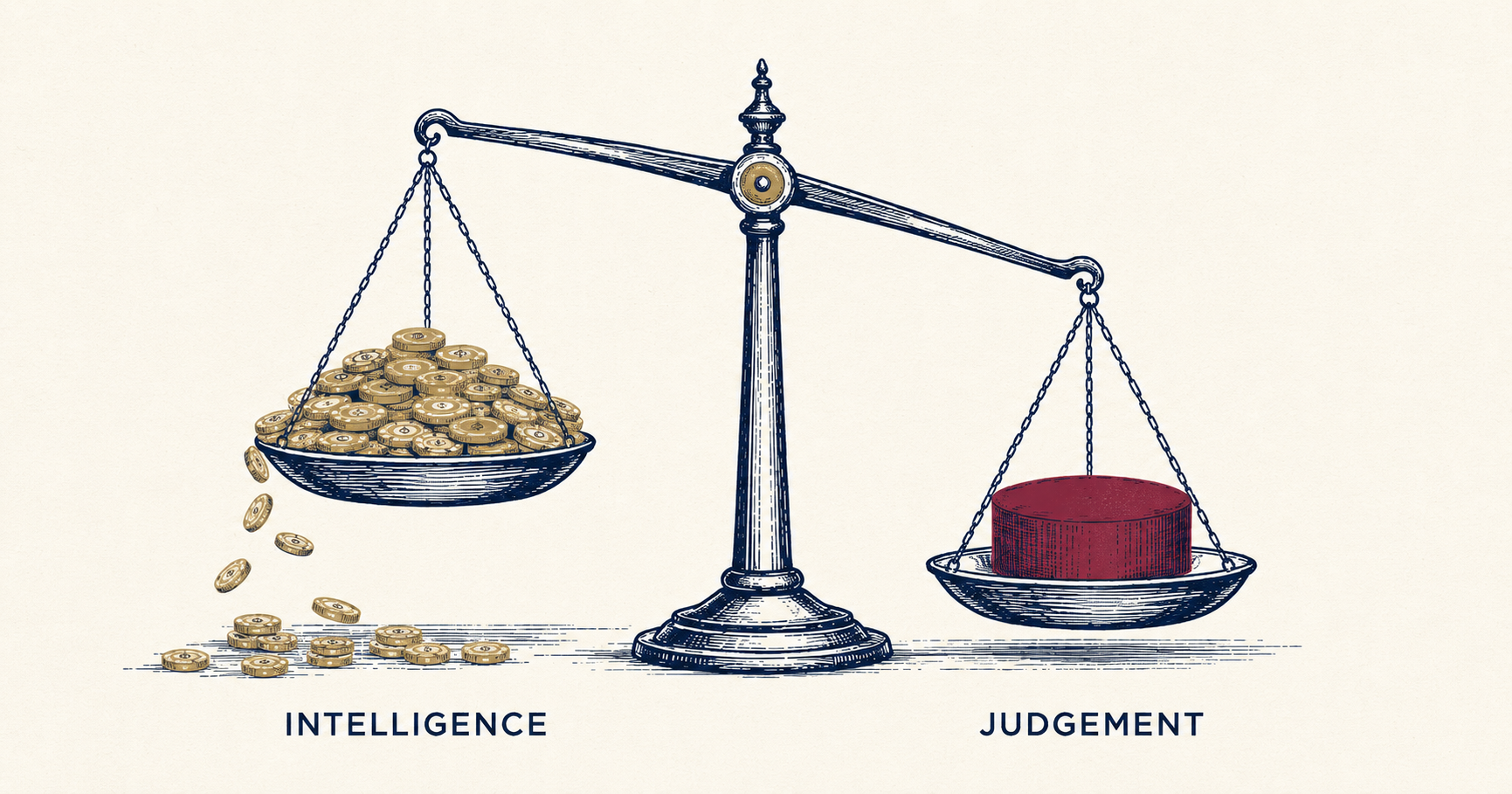
Intelligence is the substrate. Judgement is the limiting reagent. Until you treat decision quality as its own discipline, every model upgrade is a supply curve in a market with no demand.
This is the most important shift in the AI story right now, and almost nobody is naming it.
The benchmark trap
Every model release comes with a leaderboard. Reasoning evaluations, mathematics scores, coding assessments, context-window benchmarks. The trajectory is real. The engineering is genuine. The curves go up and to the right.
But there is a category error baked into the way these scores are read.
A model that scores higher on a reasoning evaluation does not produce a team that anchors less on the first option surfaced. It does not produce a procurement function that recovers from a sunk-cost commitment more quickly. It does not produce a hiring panel that pre-mortems before each shortlist. The benchmark gain stops at the chat surface. The decision discipline gap survives the upgrade intact.
Confusing the two is the most expensive misread in enterprise AI right now. Buyers see the leaderboard climb and assume the operational impact will follow. It does not. The model has nothing to push against. The judgement layer that would translate raw cognitive capability into better organisational outcomes is not part of the model. It has to be built around it.
What every team noticed in 2025
Walk into any organisation that adopted a chat tool widely in the last 18 months and the pattern is the same.
Output volume is up. Drafts are produced more quickly, summaries more readily, code more abundantly. Senior people have something resembling a tireless junior to delegate to. Productivity feels qualitatively different.
And yet, when you ask the question that actually matters - which decisions got better? - the answer is harder to find.
The same operator who decided one way on Monday decides differently on Friday because they do not remember the Monday reasoning. The same team that fell into a sunk-cost commitment last quarter falls into the same one this quarter, because the chat tool helpfully systematised the prior framing rather than challenging it. The same hiring panel anchors on the first candidate's CV format because nobody surfaced the bias before the discussion started.
The substrate got faster. The discipline did not. And the organisations that have noticed are starting to ask the right question: what would it take to make decision quality the metric we actually move?
What scarce actually means
Judgement is scarce because it has three properties, and none of them transfer with a model upgrade.
Domain-specific. The bias that ambushes a hiring decision is not the bias that ambushes a procurement decision. The cognitive trap waiting for a regulated-industry compliance call is not the trap waiting for a marketing positioning call. A model that knows about availability bias in the abstract does not know which specific bias is most likely to fire in your domain when you sit down to decide. That mapping - bias to domain to decision type - is the work the model does not do. It is what an experienced practitioner does without realising.
Bias-resistant. Reasoning has to defend against itself. Most cognitive errors are not failures of intelligence. They are failures of self-checking. The smartest person in the room can anchor as easily as the least; smarter people often anchor harder, because their justifications are more articulate. Resistance to your own reasoning is a discipline, not a capability. It requires a checkpoint before the decision, run by something that is not invested in the answer.
Cumulative. Judgement learns from outcomes, not from training data. The decision that turned out to be wrong six months ago is the most expensive teacher available - but only if the organisation captured what was decided, what was rejected, and what was actually believed at the moment of decision. Without that record, the same lesson costs the same money the next time. Training data does not solve this. The data the team needs is its own.
These three properties - domain-specific, bias-resistant, cumulative - do not come bundled with a model card. They are not produced by another quarter of capability gain. The next leaderboard release will not address them either.
The judgement layer
What does it actually look like when an organisation treats decision quality as a measurable discipline?
It looks like a checkpoint before consequential decisions, run by a system that has cognitive biases catalogued and routed by domain - in Rubicon Probity, the platform we have built for this, 153 of them, matched to the kind of problem at hand. The checkpoint is not a debate. It is a structural surface that says: this looks like the kind of call where anchoring usually fires - here is the question to ask before you commit.
It looks like a record at the moment of decision. The option chosen, the options rejected and why, the confidence the system held when it decided - captured before the outcome is known and never edited afterwards - the antecedent decisions this one inherits from, the named actor responsible. Six fields. Recorded discipline. Queryable forever.
And it looks like an outcome review weeks or months after. Not a retrospective slide deck. A structured comparison of what was expected against what happened, with the rejected branches still on the page so the team can see whether the path not taken would have done better. The review surfaces patterns - the same kind of decision keeps going wrong in the same way - and feeds them back into the bias library so the next checkpoint catches them.
Three operations, deliberately separable: check before, record at, review after. Each has a different cadence. Each fires on a different cue. Together they form a decision lifecycle the way design, build, test forms a development lifecycle.
What it is, and what it isn't
This is not a productivity tool. The judgement layer does not make decisions faster, and the gain is not in the number of decisions made.
It is a quality system. The work it does is the same work a well-run engineering function does for code, or a well-run finance function does for spend, or a well-run safety function does for operations. It defines what a good output looks like. It builds checks against the predictable failure modes. It captures the audit trail that lets the team learn from outcomes. It produces an institutional memory that survives the people who created it.
The most expensive thing your organisation produces is decisions. Most organisations cannot tell you what their decision-quality function looks like, who is accountable for it, or how it would learn from a mistake made six months ago. That is not because the discipline is unimportant. It is because nobody built the layer.
Building it is what we mean when we talk about the judgement layer. It does not arrive with the next model release. It does not fall out of the chat surface. It has to be designed, instrumented, and adopted - the same way every other quality system in your organisation was designed, instrumented, and adopted, before it became the thing nobody questions.
The gap that does not close on its own
The most uncomfortable consequence of this argument is what it implies about waiting.
If judgement is what is scarce, then the next model release does not close the gap. It widens it. The team that has not built a decision-quality function before the upgrade has more raw capability, applied to the same biased reasoning, at higher speed and greater volume. The output looks more sophisticated. The underlying judgement is unchanged. The amplifier got louder; the signal it amplifies got no clearer.
The organisations that come out of this decade ahead are not going to be the ones that adopted the most models. They will be the ones that built the decision-quality function around the models they adopted - that treated judgement as the engineered discipline it always was, and stopped waiting for the substrate to do the work the layer above it has to do.
Intelligence got commoditised. Judgement did not, and will not.
The work is to build the layer.
Alistair Hancock is the founder and CEO of Rubicon Software. He has been building operational systems for regulated industries since 1989 and now focuses on helping organisations adopt AI with the governance frameworks to use it confidently.